You're Not a Plant Killer. You've Been Gardening Blind.
After killing more than 30 plants, I finally found the real reason they kept dying — and it had nothing to do with having a "black thumb."
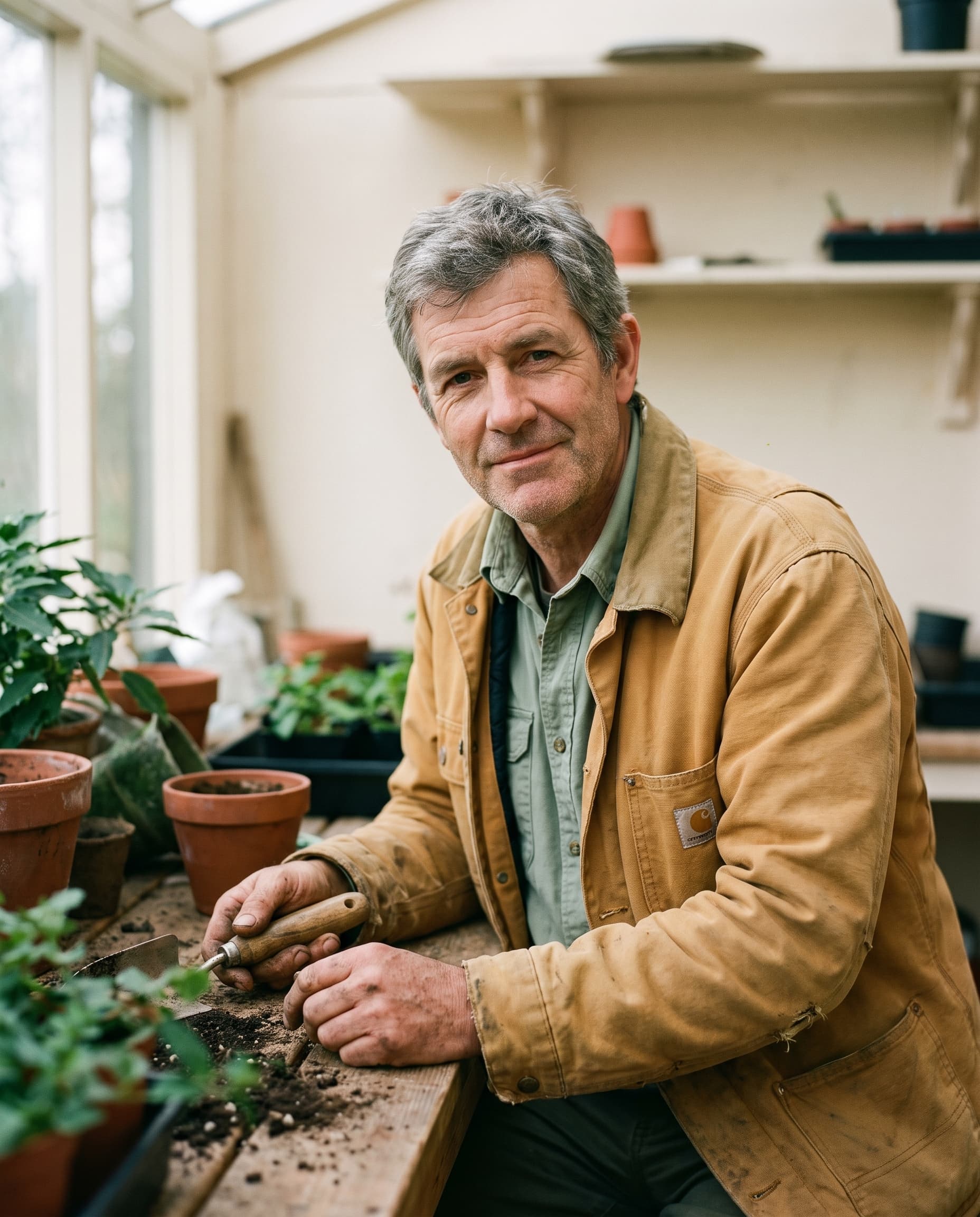
For years I thought some people were just born able to keep plants alive, and I wasn't one of them. Then a friend who grows for a living showed me the one thing I'd never checked — the thing happening under the soil, where I couldn't see it. Everything changed after that. Here's exactly what I learned.
I need to tell you something that took me three years and a lot of dead plants to figure out.
You are not a plant killer.
I know it feels like you are. I know the yellow leaves, the wilting, the plant that was fine last week and is somehow dying this week — I know all of it feels like proof that you just don't have the touch.
You've probably said it out loud. "I have a black thumb. Everything I touch dies."
I said it for years. I said it while I carried another crispy, brown fern out to the bin. I said it after I stopped buying plants altogether because I was tired of wasting the money.
It was a lie. Not a lie you told — a lie you believed, because nobody ever showed you what was actually going on.
It Was Never Your Green Thumb
Here's the truth I wish someone had handed me years ago: plants don't die because of who you are. They die because of a specific, physical cause — and almost always, it's a cause you literally could not see.
There's a name for what's really been happening. I call it Root-Zone Blindness.
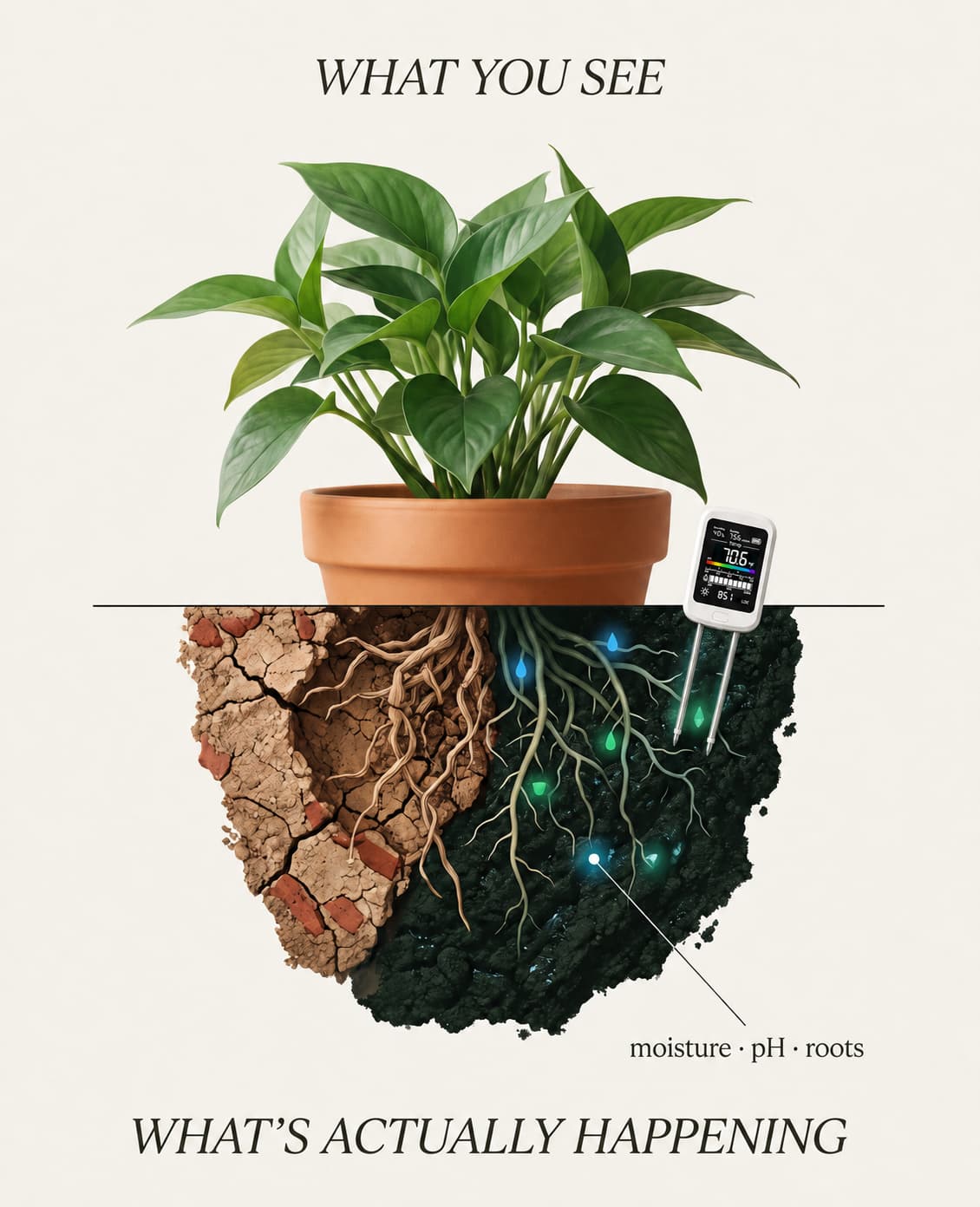
Think about it. Everything you use to judge your plant's health is above the soil. The leaves. The stem. The color. The droop. But everything that actually decides whether that plant lives or dies is happening below the soil — down at the roots, where your eyes have never once been able to reach.
The moisture at the root level. The pH. The nutrients. The temperature down where it matters. Those are the things that keep a plant alive. And you've been flying completely blind on every single one of them.
That's not a character flaw. That's not a black thumb. That's just missing information — and missing information can be fixed.
The Killer You Can't See
Here's what makes Root-Zone Blindness so cruel: the few signs you can see actively lie to you.
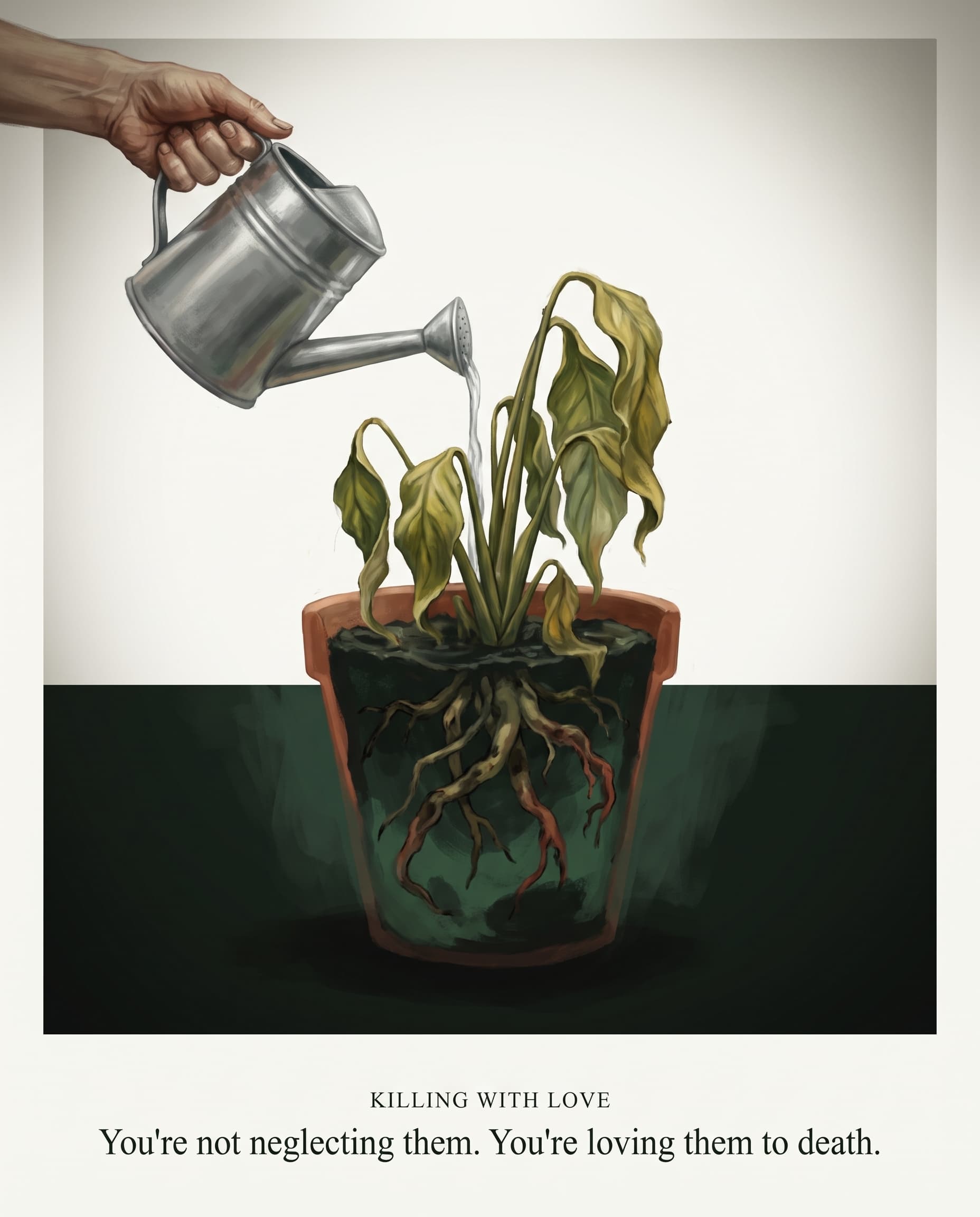
Your plant is drooping, so you do the obvious, loving thing — you water it. But a drooping, wilting plant is very often overwatered, not thirsty. Its roots are drowning and suffocating in soil that's still wet, and the extra water you just gave it out of kindness is the thing finishing it off.
There's a name for this too, among gardeners: killing with love. It's the single most common way houseplants die. And you'd never know, because the surface told you the exact opposite of the truth.
The leaves turn yellow, so you assume the plant is hungry and you reach for fertilizer. But yellow leaves are very often a pH problem, not a food problem. When the pH in the soil drifts out of range, it locks the nutrients away where the roots can't absorb them — so the plant is starving even though the food is right there. Growers describe it perfectly: your plant is starving at a full buffet. You can pour on all the fertilizer you want. If the pH has slammed the door, none of it gets in.
This is why it feels so hopeless. You're not ignoring your plants. You're responding to the signals you can see — and the signals you can see are pointing you the wrong way.
By the time the damage shows up above the soil, it has usually been building silently underground for weeks:
- Overwatered roots quietly rotting in soil that looks and feels fine on top
- Locked-out nutrients starving a plant you're actively feeding
- A pH quietly off — sabotaging everything else you do right
- Roots too cold or too hot to take up water at all
- Bone-dry pockets down at the root ball while the surface still looks damp
You never had a chance to catch any of it. Not because you weren't paying attention — but because it was all happening in the one place you were never able to look.
Why "Just Water When It's Dry" Never Worked For You
At this point you might be thinking: okay, so I'll test my soil.
I thought that too. So let me save you the money I wasted.
I bought the cheap green meters — the little dual-needle ones everyone points you to. You've probably got one in a drawer right now. Here's what mine did: it gave me the exact same reading whether I stuck it in bone-dry soil or a glass of water. The needle basically never moved. The pH function may as well have been a sticker; it never worked once.
I'm telling you this because I need you to hear it clearly: when those cheap meters failed you, that wasn't more proof that you're bad at this. It was proof that the tool was junk. There's a difference, and it matters enormously, because most people quietly conclude the whole idea of measuring your soil is a gimmick after one bad $10 gadget.
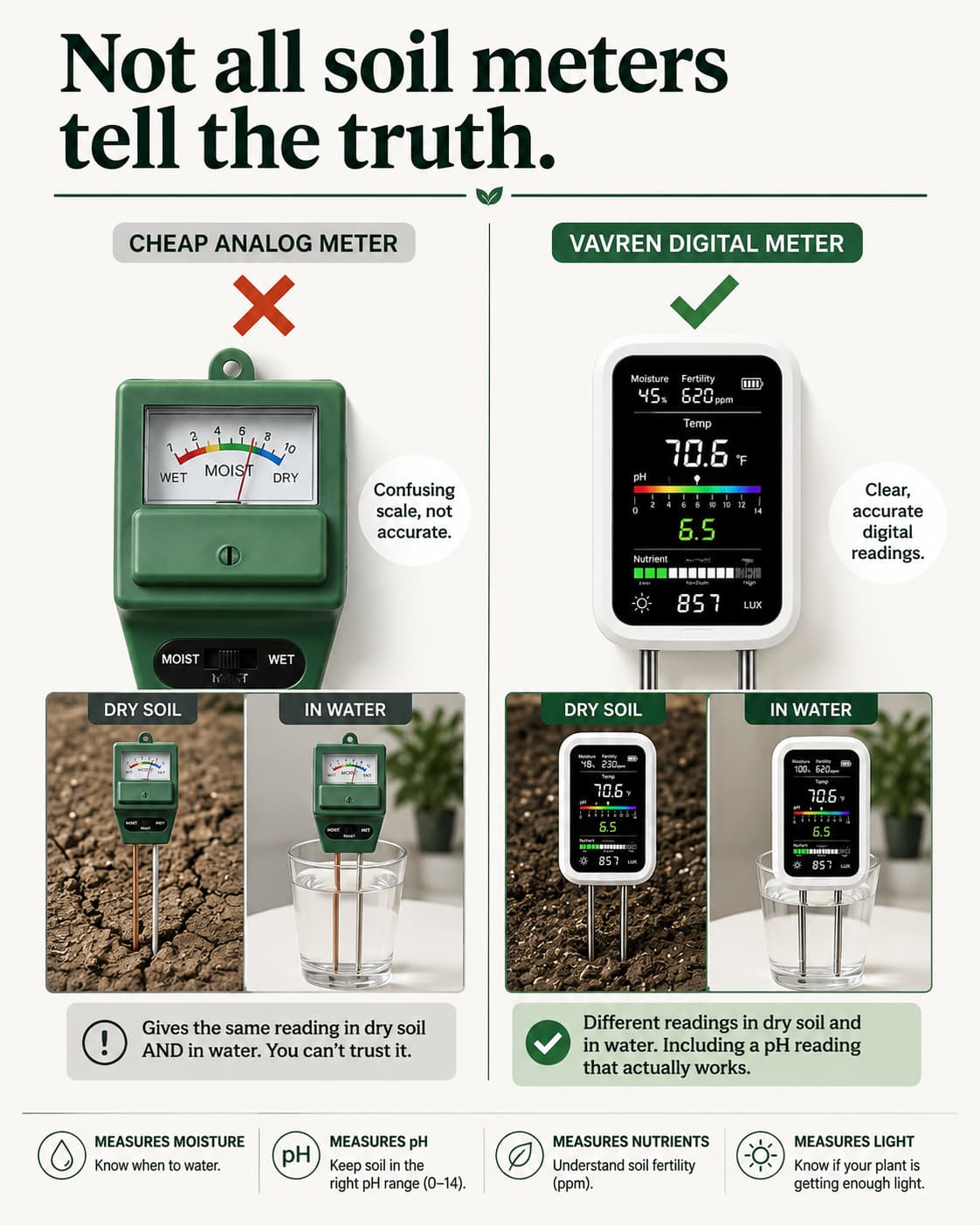
It's not the idea that's broken. It's the guessing — and the cheap tools that dress guessing up as data. As long as you're guessing, you're going to keep losing plants you love and blaming yourself for it. That was the trap I was stuck in for three years.
What Professional Growers Know That You Don't
Here's the thing that finally broke it open for me.
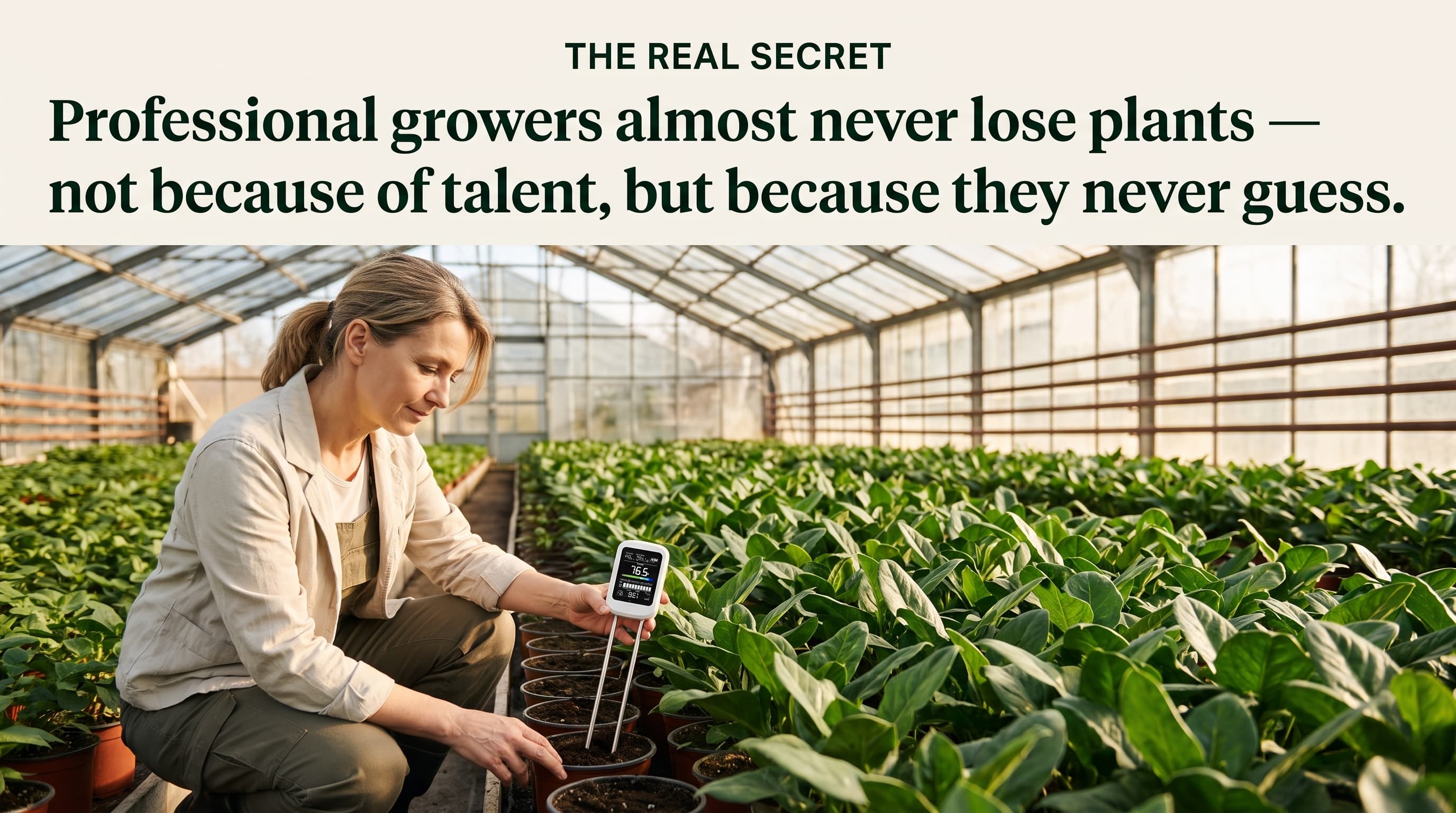
I have a friend who grows plants for a living — greenhouses, the real thing. And I asked him, half-joking, how many plants he loses. He looked at me like it was a strange question and said: hardly any.
Not because he has some magical gift I don't. Because he never guesses.
That was the whole secret. Professional growers, greenhouses, commercial nurseries — the people who almost never lose plants — they don't stand there debating whether the soil "looks" dry or wondering if it's time to feed. They measure. They know the moisture, the pH, the nutrient level, the temperature down at the root zone, as actual numbers, because they figured out a long time ago that the plant's real condition lives underground where your eyes can't go.
The reason they never seemed to have a black thumb… is that they were never gardening blind in the first place.
And when he told me that, I had one obvious, frustrated thought:
Fine. But I'm not running a greenhouse. I can't afford lab equipment, and I'm not mailing my dirt to a lab and waiting two weeks every time a leaf turns yellow. How is a normal person at home supposed to actually see any of this?
It turns out there's now an answer to exactly that question — and the first time I used it, everything I thought I knew about my "black thumb" fell apart in about ten seconds.
The First Time I Could Finally See
My friend sent me home with something called the Vavren Smart Soil Intelligence System.
I'll be honest — my first thought was great, another gadget for the drawer. I'd been burned before. But this was different in a way I felt immediately, before I even trusted it: I pushed the probe into the soil of the sad, half-dead plant I'd been overwatering for weeks, and the screen lit up with actual answers.
Not a needle twitching vaguely between "dry" and "wet." Real, clear readings. Six of them.
Because here's what Vavren does that nothing in my drawer ever did: it reads the six hidden signals inside the root zone — the exact six that decide whether a plant lives or dies — and it shows them to you in plain numbers you can actually understand.
That first plant I tested? The soil moisture reading was through the roof. I'd been drowning it. The thing I thought was thirst was the exact opposite — and for the first time in three years, I wasn't guessing about it. I could see it.
That's the whole idea. Vavren doesn't make you a better guesser. It ends the guessing. It takes the six invisible things happening beneath the surface — the things that have been quietly killing your plants while you did everything "right" up top — and it makes them visible.
Think of it like a check-engine light for your plants. You don't have to be a mechanic to know something's wrong and what to do about it — the dashboard just tells you.
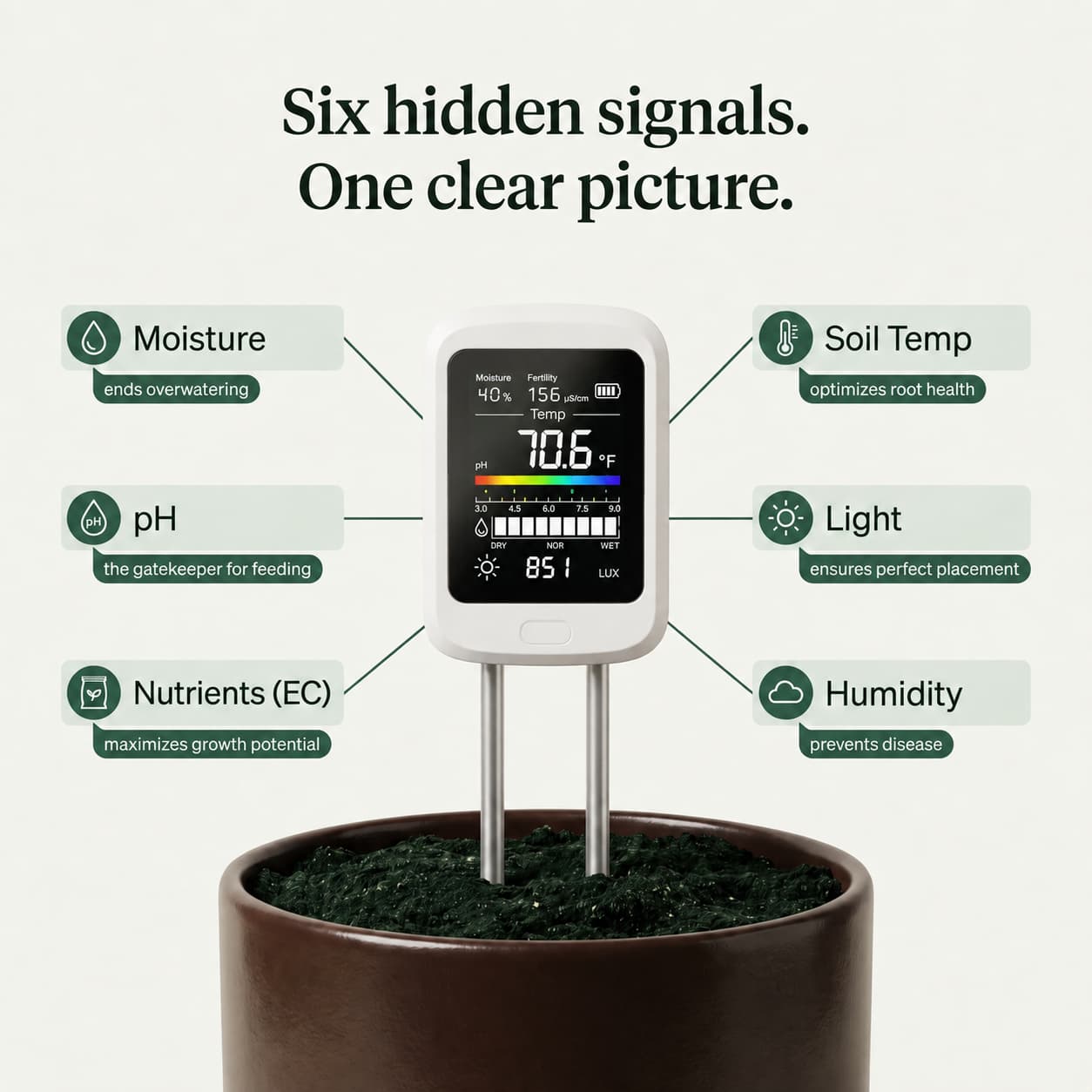
And this is the part that mattered most to me, because I'm not a soil scientist: it doesn't just throw numbers at you. Each reading comes with the healthy range for what you're growing, so you're not left googling "is 6.2 pH bad" at 11pm. You see the number, you see where it should be, and you know what to change. Numbers you can read. And answers you can act on.
A quick, honest word on the "cheap meter" problem
I know what you're thinking, because I thought it too: how is this any different from the $10 one that lied to me?
Fair. So here's the straight answer, point by point:
- The readings are consistent and calibrated — not a needle that shows the same thing in dry soil and a glass of water.
- The pH reading actually works — the single most common failure of the cheap meters, and the whole reason most of them end up in the drawer.
- It's instant and you can check any time — no mailing soil to a lab and waiting two weeks for one plant.
- No app, no WiFi hub, no setup headache — you push it into the soil and read the screen. That's it.
- It's USB-C rechargeable — so there's no hunting for weird batteries.
It's the difference between a toy that pretends to measure and a tool that actually does.
See what my plants needThe Day I Stopped Calling Myself a Plant Killer
I want to tell you what actually changed, because it wasn't just one plant.
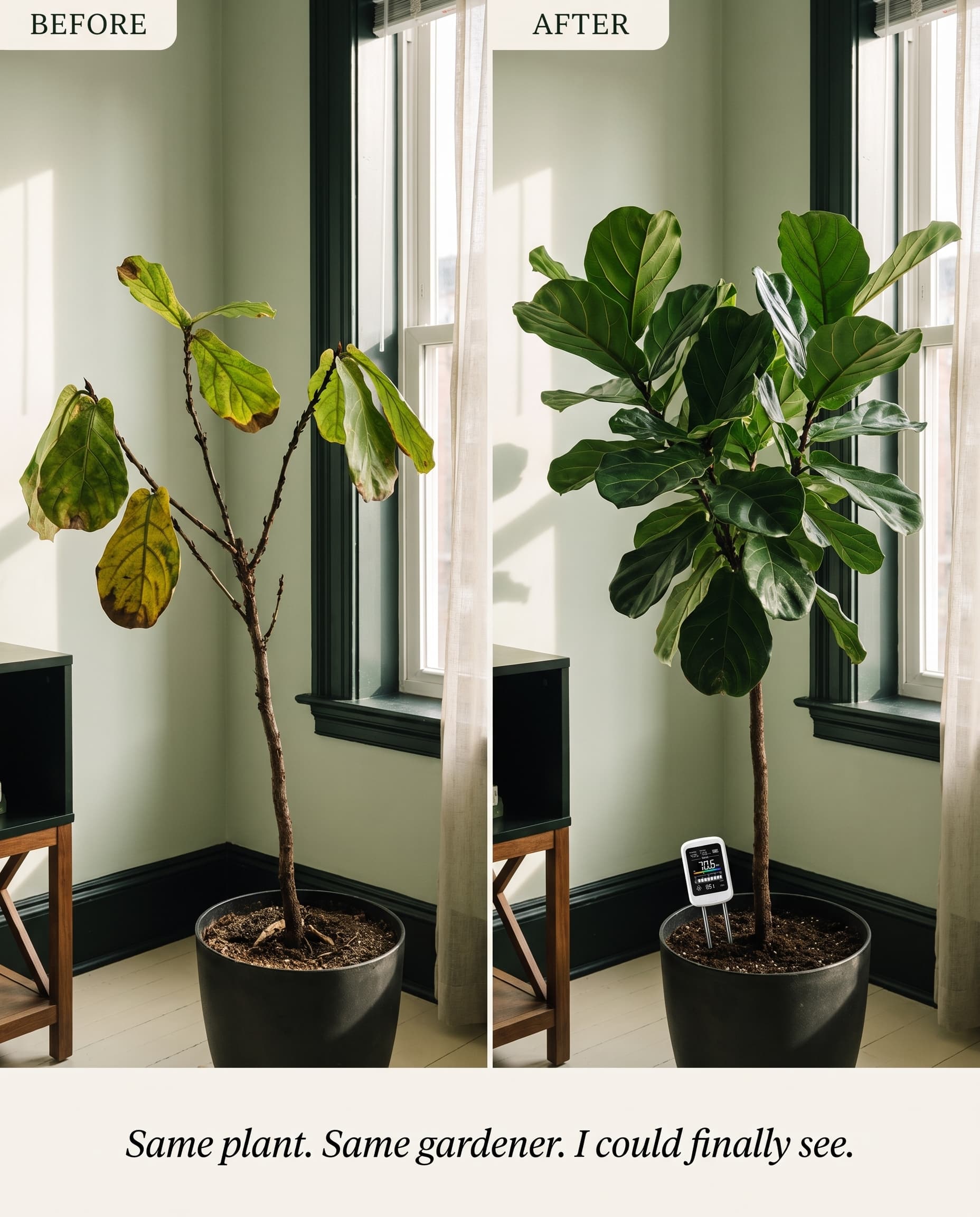
Once I could see, I stopped making the invisible mistakes. I watered when the root zone was actually dry — not when I was anxious. I fixed a pH problem that had been quietly starving a plant I'd been faithfully fertilizing for months. I moved two plants that were sitting in light that was all wrong for them.
Within a few weeks, the plants I'd written off came back. Greener. Fuller. One of them flowered for the first time since I'd owned it.
And somewhere in there, the story I'd told myself for three years just… dissolved. I wasn't a plant killer. I never had been. I'd been gardening blind — and the moment I could see, I turned out to be perfectly capable of keeping things alive.
That's the real thing Vavren gave me. Not six numbers. Confidence instead of dread. The quiet certainty of knowing what my plants need, instead of hoping and bracing for the next funeral.
The Math That Made It a No-Brainer
Let's talk about what this costs — because I put off buying things like this for years on price, and I want to actually run the numbers with you the way I finally ran them for myself.
Here's what Root-Zone Blindness had already been costing me, every year, without me noticing:
| Replacing plants that kept dying (over and over) | $100+/yr |
| Fertilizer & "fixes" for problems I'd misdiagnosed | $40 wasted |
| A single mail-in lab soil test (one plant, one time) | ~$30 each |
| The prized plant I couldn't replace at any price | priceless |
| Vavren — works on every plant, indoors and out, for years | $89.99 once |
When I saw it laid out like that, the question flipped. It wasn't "can I justify spending $89.99?" It was "how much have I already thrown away by not having this?"
One tool. Every plant you own. However many seasons you garden. That's the actual math.
Vavren Smart Soil Intelligence System
Stop guessing. See exactly what your plants need.
- Reveals all 6 hidden root-zone signals — moisture, pH, nutrients, temperature, light, humidity
- Clear, reliable readings you can actually trust — including a pH reading that works
- Tells you the healthy range for what you're growing, so you know what to do
- Instant results — no lab, no app, no WiFi hub, no guesswork
- USB-C rechargeable — no disposable batteries to hunt for
- Includes the "What Your Readings Mean" quick-start guide
One last thing.
If you've got a plant declining right now — the one you keep looking at, hoping it turns around — you don't have to keep guessing at it. You can stop wondering whether it's too much water or too little, whether it's hungry or whether the pH has locked the food away, and just look.
You were never a plant killer. You were just gardening blind.
It's time to see.
See what my plants need